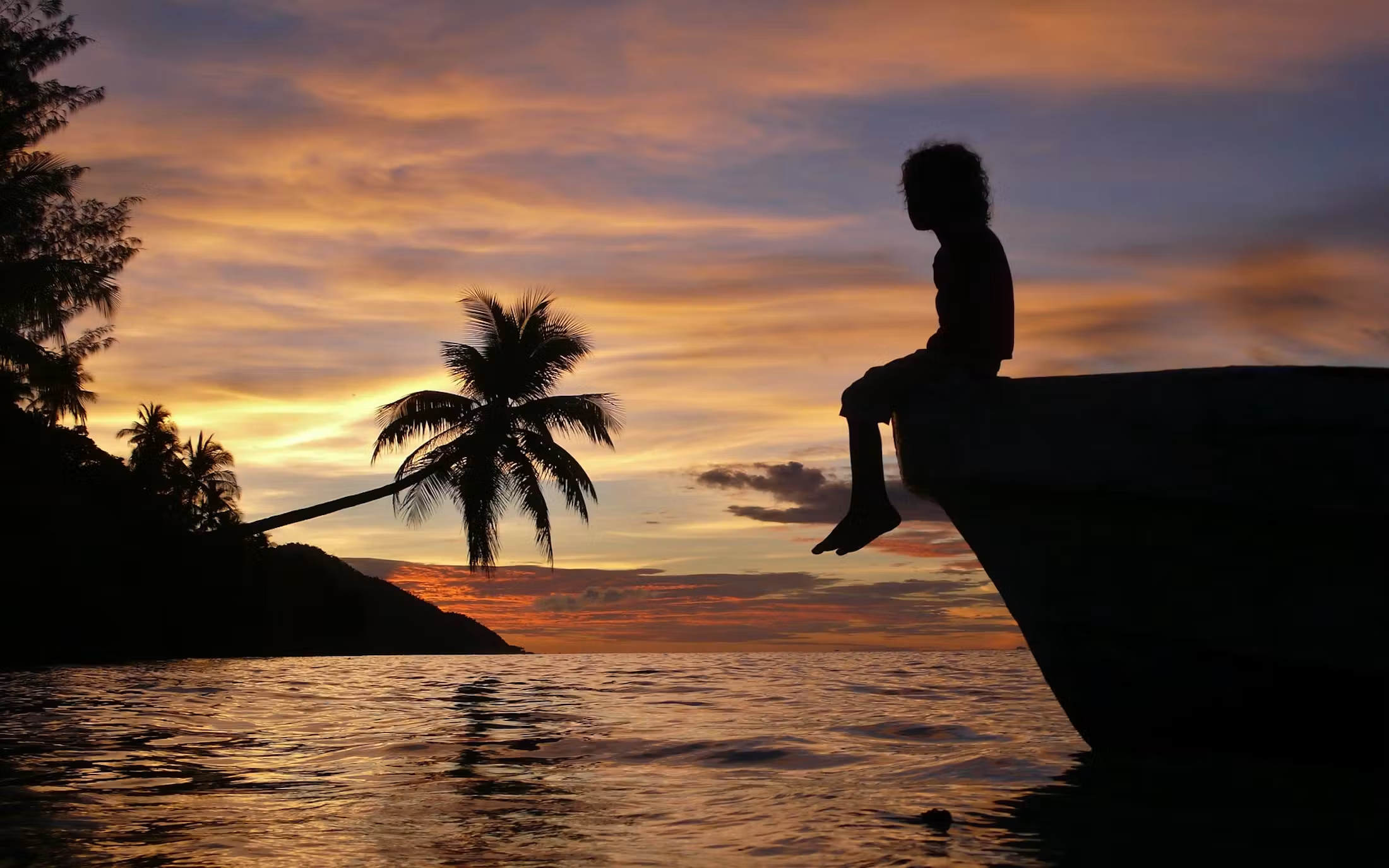
In Raja Ampat, Children Are Learning to Become Island Stewards
“Rockhead fish, salamander fish, starfish and coral.” That’s what dozens of children from Arborek, a small island in Indonesia’s Raja Ampat archipelago, said when asked what they see in nature that is yellow and orange. The children rattled off the fish and other marine life they encounter when they play in the sea, during a reading of a children’s book about Raja Ampat and the threat of nickel mining. Research suggests that children who grow up closely connected to their surroundings can develop sophisticated understandings of their local environment. A 2014 study of children in 22 villages in Indonesian Borneo, for example, found that they recognised relationships among forests, rivers, wildlife and other environmental changes. So Sekar Bestari, the book’s illustrator, wasn’t surprised by the children’s answers. “Most of the time when we read the books to children, they understand them, so don’t underestimate children’s knowledge,” she said after the reading in Arborek. “We’re not surprised anymore today.” The reading was part of a three-day gathering of Indigenous communities in Arborek that brought together representatives from 20 Indigenous subtribes in Raja Ampat, as well as Indigenous people from other parts of Indonesia and abroad. The gathering, organised by Greenpeace Indonesia and local NGO Institut USBA, was intended to strengthen solidarity among Indigenous communities in protecting their lands, waters and biodiversity. The children’s knowledge of their surroundings also emerged in less expected ways. Titah Asmaning Winedar, the book’s author, recalled meeting a girl named Esther who told her there was a way to call sea turtles. “She said you just split open a coconut and leave it in the sea,” Titah said. For Titah and Sekar, such knowledge is part of what they hope the book will encourage children to value — and eventually to document and tell themselves. “When they see that a Raja Ampat story has been made into a book like this, our hope is that they feel, ‘Oh, my story is important too,’” Titah said. A story told through colours The book, titled Luka-Luka Pulau Kecil (The Wounds of Small Islands), tells the story of Pin, a child who loves swimming in the sea and lives in a stilt house surrounded by white sand. Pin loves rainbows because they are full of different colours, just like her home. She often thinks to herself, “Ah, the rainbow must have borrowed all its colours from its surroundings.” Colours are central to the story. For the people of Raja Ampat, Titah said, the colours of the natural environment are more than something beautiful to look at. They can represent the health of the islands and their biodiversity. “I realised this from looking at photos and snorkelling videos from Raja Ampat,” she said. “I thought, ‘Wow, it’s so colourful.’” She then asked two Greenpeace volunteers from Raja Ampat what kinds of plants and animals they encountered around their homes. They mentioned flowers and other colourful elements of the landscape. Rainbows also frequently appear in Raja Ampat, Titah said. Raja Ampat lies in the heart of the Coral Triangle and is one of the world’s most biodiverse marine regions. Researchers have estimated that its waters contain about 75% of the world’s known coral species. The book turns that biodiversity into a visual story about what could be lost if mining damages the environment. One day, while Pin is happily playing, she hears a rumbling sound from the sea. It turns out to be a giant barge carrying several huge excavators. The next day, the rainbow appears without its red colour, obscured by smoke from the mining activity. At the same time, Pin sees a red hibiscus flower wilting, a bird-of-paradise becoming weak and red coral dying. As mining continues, the colours of the rainbow — and the plants and animals they represent — disappear one by one. “Are you sad if the marine animals disappear?” Sekar asked the children. “Very sad,” they responded. Nickel’s return to the conversation The story comes as Raja Ampat remains at the centre of a debate over nickel mining. Nickel, used primarily in stainless steel and increasingly in some electric vehicle batteries, has become a major commodity for Indonesia. The country’s nickel mine production rose from about 130,000 metric tons in 2015 to 2.2 million metric tons in 2024, according to the US Geological Survey, making Indonesia by far the world’s largest producer. Most of Indonesia’s nickel mining is concentrated in Sulawesi and North Maluku. But several islands in Raja Ampat have also been targeted for mining. Public concern over nickel mining in Raja Ampat erupted in 2025 after images of forest clearing and environmental damage were widely shared on social media. The backlash prompted the government to suspend mining operations and later revoke four of the region’s five nickel mining permits. The remaining operation, the state-owned PT Gag Nikel, continues to mine on Gag Island. Greenpeace says the government actions have not eliminated the threat of future mining in the archipelago. Its latest research identifies two companies seeking to develop nickel projects in eastern Waigeo, Raja Ampat’s largest island, and another company seeking a coal permit in Misool. Greenpeace had initially described three companies as pursuing nickel projects but issued a clarification in August 2026 saying that one of the three was actually seeking a coal permit. Waigeo is home to endemic wildlife including Wilson’s bird-of-paradise (Cicinnurus respublica), the Waigeo brushturkey (Aepypodius bruijnii) and the Waigeo spotted cuscus (Spilocuscus papuensis). Residents of Arborek say they are concerned that mining elsewhere in Raja Ampat could affect the waters and ecosystems on which communities across the archipelago depend. Benoni Watem, a 43-year-old resident of Arborek and an owner of a homestay business, said he firmly rejects mining in Raja Ampat, because it could harm the beauty of the ecosystem, which is one of the main reasons why tourists come to the region. Arborek is the closest village to the famed Manta dive and snorkeling sites. “The beauty of Raja Ampat is what brings tourists here. But if mining comes in, the environment that we have protected will be damaged by mining, and then the beauty will disappear,” Benoni said. He’s worried that waste from mining will end up in the ocean and ultimately kill marine life, such as manta rays — the largest species of all rays that are threatened with extinction due to their slow reproductive rates and large number of threats. “Manta rays might become uncomfortable. If waste enters the sea, their food will disappear,” Benoni said. “When there are manta rays, guests get excited and happy.” The concern is not only for wildlife. George Mentansan, an anthropologist who spoke at the Arborek gathering, said environmental damage could also threaten the cultural diversity of Raja Ampat. Indigenous communities have developed their own systems for managing natural resources, including ecological calendars, areas protected by customary rules and restrictions on catching certain marine species.