VIS 2026VIS 2026 — Virtual Island Summit|Also: GSIS 2027GSIS 2027
Island Innovation Logo
About
Services
The Network
Events
Content Library
Contact Us

Subscribe to our newsletter. By submitting, you agree to our Privacy Policy.

Island Innovation

Island Innovation works with governments, institutions, and partners worldwide to support island-led sustainable economic development.

We Support The UN Development Goals

SDG 9: Industry, Innovation and InfrastructureSDG 11: Sustainable Cities and CommunitiesSDG 12: Responsible Consumption and ProductionSDG 13: Climate ActionSDG 14: Life Below WaterSDG 17: Partnerships for the Goals

Explore

AboutServicesNetworkEvents

Content

ArticlesNewsCareers

Ready to Connect?

Join the island innovation community

Get in Touch

About

  • About us
  • Case Studies
  • FAQs
  • Press
  • Careers
  • Contact

Services

  • Services Overview
  • Public & Media Relations
  • Strategic Communications

Network

  • The Island Network
  • Academic Council
  • Newsletter

Events

  • Our Events
  • Watch Past Events

Content

  • All Content Library
  • Videos
  • Articles
  • News
Privacy PolicyTerms of ServiceContact

© 2025 Island Innovation. All rights reserved.

    News

    Curated stories and analysis from islands and sustainability leaders worldwide.

    Filter by Core Theme

    All ThemesCircular EconomyClimate ActionConnectivity & DigitizationCulture & CommunityEnergy & TransportGreen Finance & EconomyOcean & BiodiversityPolicy & GovernanceTourism & Remote WorkWater & Food
    Showing 8 of 89 news items in Water & Food
    What is the UN 2023 Water Conference and why is it so important? Two experts explain
    Water & FoodMarch 23, 2023

    What is the UN 2023 Water Conference and why is it so important? Two experts explain

    Our global water system is in crisis. Despite safe water and sanitation being a human right, billions of people lack access to these essentials for life, according to the United Nations. This month’s [UN 2023 Water Conference](https://sdgs.un.org/conferences/water2023) – the first in almost 50 years – could be a watershed moment for [UN Sustainable Development Goal 6](https://sdgs.un.org/goals/goal6): ensuring the sustainable management of water and sanitation for all. These are the critical foundations on which many of the 17 Sustainable Development Goals (SDGs) depend, especially health, food, gender equity, education, livelihoods, industry, climate and the environment. We hope it could result in a “Paris moment” for water – with outcomes as critical for water as the Paris Agreement has been for climate action. **The Conferencehas five themesthat support theSDG 6 Global Acceleration Framework:** 1. Water for Health: Access to ‘WASH’ (Global Water, Sanitation, & Hygiene) including the Human Rights to Safe Drinking Water and Sanitation 2. Water for Sustainable Development: Valuing water, the water-energy-food nexus and sustainable economic and urban development. 3. Water for Climate, Resilience and Environment: Source to sea, biodiversity, climate, resilience and disaster risk reduction. 4. Water for Cooperation: Transboundary and international water cooperation, cross sectoral cooperation and water across the 2030 Agenda. 5. Water Action Decade: Accelerating the implementation of the objectives of the Decade for Action, including through the UN Secretary-General’s Action Plan. 1. Water for Health: Access to ‘WASH’ (Global Water, Sanitation, & Hygiene) including the Human Rights to Safe Drinking Water and Sanitation 2. Water for Sustainable Development: Valuing water, the water-energy-food nexus and sustainable economic and urban development. 3. Water for Climate, Resilience and Environment: Source to sea, biodiversity, climate, resilience and disaster risk reduction. 4. Water for Cooperation: Transboundary and international water cooperation, cross sectoral cooperation and water across the 2030 Agenda. 5. Water Action Decade: Accelerating the implementation of the objectives of the Decade for Action, including through the UN Secretary-General’s Action Plan.

    12345678910
    Read more
    Improving water access in remote and isolated communities
    Water & FoodMarch 23, 2023

    Improving water access in remote and isolated communities

    Griffith University contributed to a [global review](https://www.thelancet.com/journals/langlo/article/PIIS2214-109X(23)00006-2/fulltext) highlighting the effects of racism, social exclusion and discrimination on achieving universal safe water and sanitation in high-income countries and published in The Lancet Global Health. Griffith Cities Research Institute and Coauthor Associate Professor Cara Beal said despite Australia being one of the richest per capita countries in the world, clean, reliable water and energy provision in Australia’s First Peoples communities has long been inadequate. “Australian First Peoples do not enjoy the same level of service for water and energy that the majority of non-Indigenous Australians do, and the issue is finally getting the attention it deserves,” Associate Professor Beal said. The findings in a recent water industry report released formally by Minister for Indigenous Australians Linda Burney prompted an announcement by the Federal Government to commit $150 million over four years to support First Nations water infrastructure. “Remote and isolated communities experience water insecurity in ways that are specific to location, climate and culture – it’s not enough to simplify the management of water and energy resources from a city management perspective – we must collaborate with the people who live it and experience it every day,” Associate Professor Beal said.

    Read more
    Bringing Food to Remote Island Communities Devastated by Two Cyclones in One Week
    Water & FoodMarch 22, 2023

    Bringing Food to Remote Island Communities Devastated by Two Cyclones in One Week

    As food supplies have dwindled on cyclone-torn Tanna Island, Vanuatu, local members and missionaries from The Church of Jesus Christ of Latter-day Saints in Port Vila have worked tirelessly to find a way to get sustenance to the people on the outer island. Back-to-back category 4 Cyclones Judy and Kevin tore through houses and trees, destroying homes, buildings and food sources on March 1-3. The torrential rains drenched crops of staples such as manioc and taro, while the catastrophic winds tore down banana and mango trees leaving behind spoiled and rotting food with no future means of sustenance available. Amazingly, there have been no reports of lives lost on any of the islands. Getting relief to Tanna to bridge that life-threatening gap required miracles along with the determined efforts of Church leaders, missionaries, members and friends to make it happen. “Somehow it just all came together,” President Messick said. Humanitarian aid funds from the Church were sent to local leaders to use to secure food for both Efate and Tanna Islands. As reported by President Messick, Vanuatu stores are rationing supplies, so it was no small miracle that they found 1,300 large 18 kg sacks of rice,150 cases of tuna, noodles, bags of seeds, 150 tarps to shelter families, and 800 large garbage bags to send to the villages of Tanna.

    Read more
    Time to step up investments in rural communities on the frontline of climate change in the Pacific islands
    Water & FoodMarch 13, 2023

    Time to step up investments in rural communities on the frontline of climate change in the Pacific islands

    The International Fund for Agricultural Development (IFAD) is advocating for more investments in small-scale farming communities in the Pacific. With climate change intensifying and more frequent disruptions in food value chains, such investments are critical to fight poverty and malnutrition, and to enable rural populations to grow more food today and in the future. At the Pacific Week for Agriculture taking place in Fiji this week, IFAD delegates shared their organization’s vision and [new strategy to work with Small Island Developing States](http://tracking.vuelio.co.uk/tracking/click?d=nOU2100emp1BemrhMknk2CFgaJsmhQggNKorapUTBmT_KYt9zeaaeJ3Y8plrxRZ9eRHMy2EUYVgehFqPRrEPq3guu2o9oluCOEeYYhbfEN6H4BDhGe8F169TP6UyR4ucAETIrzuUVfybPPJWTygn7xsD3gN7YNCY3oOJGjCJBumGVKzdJtGkjPEgXmgnWWu6Nte-L94-SXyC-oCyrgDX_5P_P82Hllra5LCdkPM5eoWU0) (SIDS). Across the Pacific Island states, IFAD fosters community driven development. The Fund works closely with subsistence farmers and remote rural communities, engaging with farmer organizations, indigenous people and grassroots communities. IFAD supports climate-smart and nutrition sensitive practices such as planting drought resistant fruit and vegetable crops, establishing community nurseries, and promoting agroforestry and home gardens. The Fund also helps producers connect to commercial value chains and export markets. Over the past few decades, IFAD has made a substantial investment in the Pacific region, resulting in significant impact on the ground. Total investment by IFAD in the Pacific region amounts to US$420 million since 1978. For example, in Papua New Guinea, a project helped forge links between farmers, cocoa and coffee producers’ off-takers and agribusinesses. Thanks to training in sustainable production practices, the value of cocoa and coffee sales increased by 82 percent, leading to a 33 percent increase in food security for small-scale farmers and their families.

    Read more
    Pacific partnership for water in action
    Water & FoodMarch 9, 2023

    Pacific partnership for water in action

    **Kiribati** is one of the smallest, most dispersed countries in the world. Half of its citizens live on hard-to-reach outer islands and the other half live on the main island of South Tarawa; one of the most densely populated areas in the Pacific. The country is extremely vulnerable to rising sea levels, increased water salination, and unpredictable weather patterns, with limited resources for government services in the outer islands. The GWSP has provided critical assistance in exploring water security and sanitation service options for South Tarawa, which has uniquely fragile water resources. The 2018 study helped to generate funding of more than $58 million, with $15 million from the World Bank. Recent GWSP support in 2021 included gathering input from several experts to update the South Tarawa sanitation roadmap, which guides investments and reforms in the sanitation sector over the next 20 years. In **Papua New Guinea**, one of the most in-need countries in the Pacific, access to water and sanitation services is low, and has steadily decreased over the past two decades. With World Bank support, the country drafted and adopted its first national WASH policy in 2015. The GWSP has supported the country’s implementation of the policy, which has led to a $70 million World Bank funded project which began in February 2017. Neighboring **Solomon Islands** is rapidly urbanizing, and the population of the capital, Honiara, is expected to triple in just 30 years. To help inform decision-making around how best to ensure this growing population is served with adequate water and sanitation, the GWSP funded a study on water and sanitation service delivery options for settlement communities—which are home to more than 30 percent of Honiara’s population. The results have informed investments in a program focused on WASH services in settlements totaling $82.3 million, which includes World Bank support of $15 million

    Read more
    Locally-sourced – How Kiribati is shoring up food security and community resilience in the face of global climate change
    Water & FoodMarch 9, 2023

    Locally-sourced – How Kiribati is shoring up food security and community resilience in the face of global climate change

    With most islands just 1 to 3 meters above sea level, and with an average width of only a few hundred metres, Kiribati is extremely vulnerable to the impacts of climate change. Damaging storm surges, more extreme weather, changing rainfall patterns, and warming oceans all pose a serious and increasing threat to the low-lying island nation. Recognising the challenges, the Government of Kiribati has developed and is now implementing a comprehensive [9-year plan](https://unfccc.int/sites/default/files/resource/Kiribati-NAP.pdf) for advancing climate change adaptation and reducing disaster risk. The plan, closely aligned with the [national vision for sustainable development](https://www.president.gov.ki/resources/kiribati-20-year-vision-kv20.html), identifies increasing water and food security, including promoting healthy and resilient ecosystems, as one of the plan’s 12 key strategies. In 2016, the Government launched a project dedicated to enhancing food security in the context of accelerating global climate change. Supported by the[Global Environment Facility-Least Developed Countries Fund](https://www.thegef.org/what-we-do/topics/least-developed-countries-fund-ldcf) and [UN Development Programme](https://www.undp.org/pacific), nine stakeholders from across the government of Kiribati have worked closely with communities on three pilot islands – Maiana, Abemama and Nonouti. Pilot island communities are already seeing positive changes as a result of the project, with enhanced food supply on land and from the sea.

    Read more
    Mālama: Restoring Maui’s Olowalu Valley
    Water & FoodFebruary 2, 2023

    Mālama: Restoring Maui’s Olowalu Valley

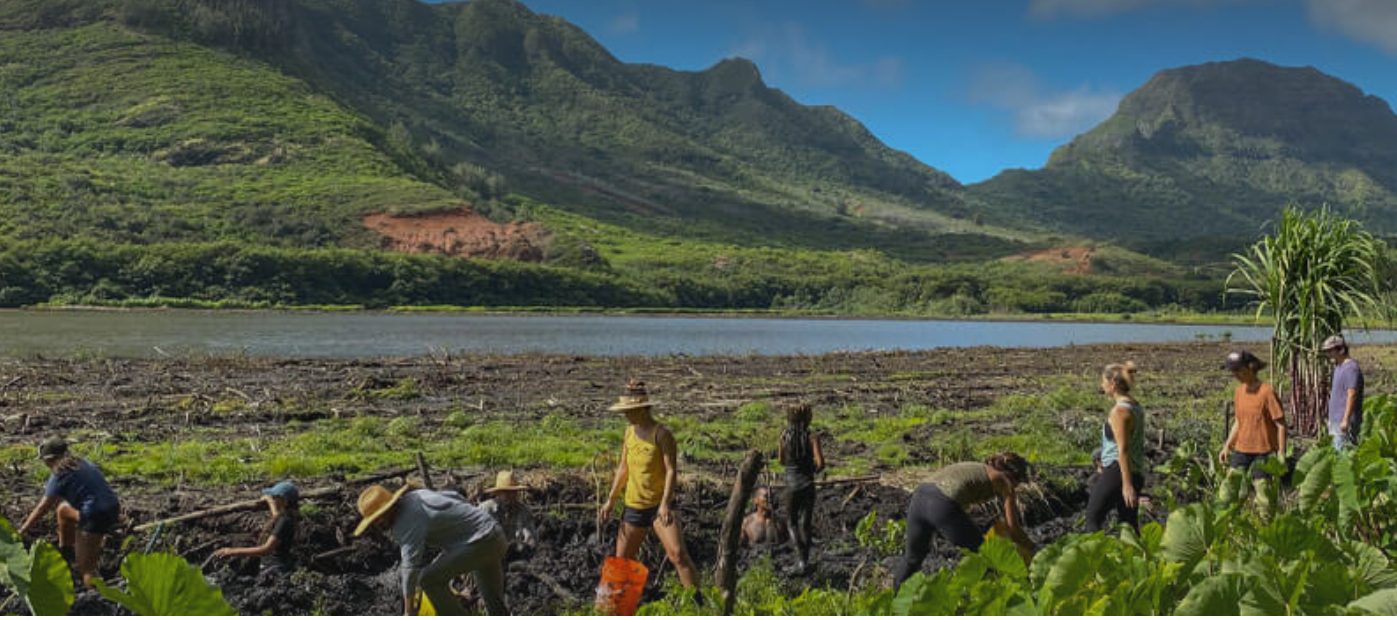
    Nestled on Mauna Kahālāwai on Maui is a hidden oasis. Native Hawaiian plants like the a‘ali‘i, a shrub with small green leaves and burgundy flowers, grow in a forest among naio, a false sandalwood, and alehe‘e, a tree with delicate and fragrant white flowers. Nearby, kalo (taro) sprout from a lo‘i (an irrigated terrace, especially for taro) alongside tubers of ‘uala (sweet potato). This is Kipuka Olowalu, a reserve committed to reviving the native ecosystems and biodiversity of Maui’s Olowalu Valley, which stretches from the mountains to the 1,000-acre reef below. Many cars pass Kipuka Olowalu on the drive to Lahaina—it’s above the famed Leoda’s Kitchen and Pie Shop—but it’s likely very few of the people in them are aware of the area. Like many natural sites and landmarks in Hawai‘i, Olowalu Valley has a fascinating history—and one that is still being unraveled. Olowalu is known for its reef and petroglyphs, but resources suggest it was once an area of refuge for those seeking sanctuary.

    Read more
    Indonesian coastal community embraces sustainable fishing challenge
    Water & FoodJanuary 12, 2023

    Indonesian coastal community embraces sustainable fishing challenge

    Fishers in this village on the northwestern tip of Selayar Island, in eastern Indonesia’s South Sulawesi province, are a fortnight into a community experiment. For three months, from mid-November to mid-February, they’ve committed to zero extraction or exploitation of the 6 hectares (15 acres) of sea off Jeneiya Kahu-Kahu Beach. That means no fishing, seaweed cultivation, shellfish collection, or throwing of trash. Definitely no fish bombs, added Andri Mustain, coordinator of the Selayar Islands program of the Bali-based Indonesian Nature Foundation, known locally as Yayasan LINI. “The [closure] agreement states that in all coastal and marine areas of Kahu-Kahu village, it is strictly prohibited to catch fish using toxic materials and or fish bombs that damage the environment,” he said. “The hope with this closure activity is that the community sees themselves managing their own resources.”

    Read more